Today’s entry in the Guitar Fail Lexicon…
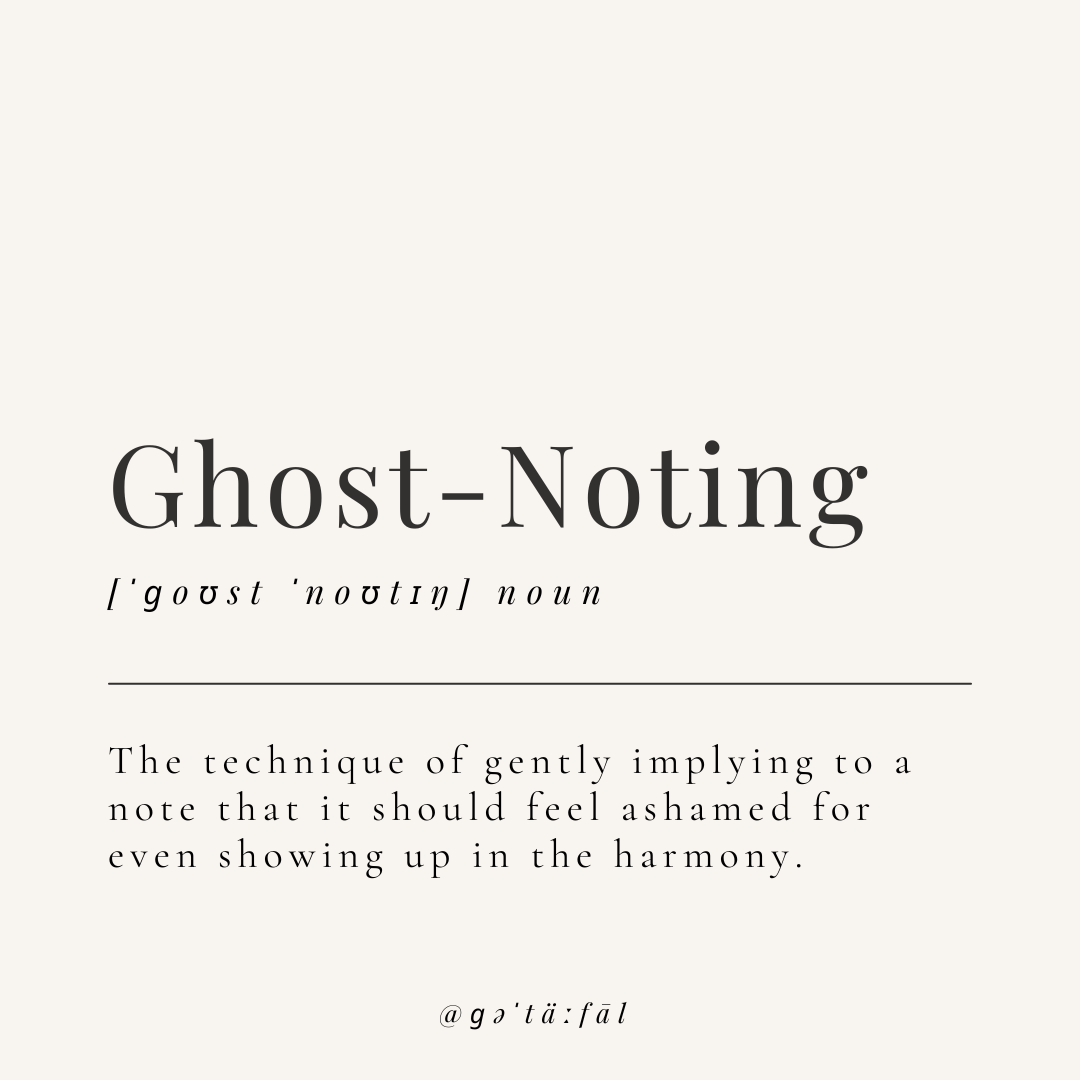
Ghost-Noting |ˈɡoʊst ˈnoʊtɪŋ | noun
The technique of gently implying to a note that it should feel ashamed for even showing up in the harmony.
Let’s break down this imaginary word for a very real guitarist technique, shall we? Or maybe it’s a real word for a very imaginary guitarist technique… Anyway, let’s break it down !
What is Ghost-noting ?
Let’s paint a picture… You’re noodling on the fretboard. You’re spitting notes like there’s no tomorrow. You’re in the zone… the shred zone ! It feels kinda good but something feels off !
That’s because it is !
The harmony is cluttered with notes ! You need to take action to declutter that thing but there’s a catch…
You like cascading notes ! You want to make as many notes as humanly possible like some music machine gun…
Notes are your bullets !
Eardrums are your target !
And you wanna keep that target stuffed with your musical ammo !
What Happens During Ghost-noting?
When properly executed, ghost-noting sends a very clear message to the offending note:
“Thank you for your interest in this harmony.
Unfortunately, we’ve decided to move forward with other candidates.”
The note is still technically there. But barely. You haven’t removed it. You haven’t muted it. You haven’t even lowered its volume that much.
You’ve simply made it aware that its presence is no longer appreciated.
A clever note usually gets the hint and quietly leaves on its own. At least that’s what musicologists, and all sorts of music nerds believe.
Can Notes Recover From Ghost-noting?
In many cases, yes. A note that has been ghost-noted may eventually find purpose elsewhere.
Some become passing tones. Others are rehabilitated into tasteful melodic devices. A few even go on to become funky notes or even jazz notes for the boldest.
Unfortunately, not all notes are so lucky. Some end up becoming bass notes.
Do’s and Don’ts of Ghost-noting
Do’s
- Ghost-note excessive notes before they spread.
- Apply ghost-noting early. Harmony clutter is easier to prevent than to cure.
- Remember that sometimes the most beautiful note is the one you don’t play.
- Remember that just because you play a note doesn’t necessarily mean it’s a beautiful note
Don’ts
- Don’t ghost-note every note… Unless you aim to scare the audience !
- Don’t attempt to ghost-note a drummer. Results are inconsistent.
- Don’t ghost-note an entire solo. That’s called forgetting the changes.
Are you Ready to Ghost-Note Your Way Out of a Cluttered Harmony ?
Hope this helps you navigate the delicate art of harmonic conflict resolution.
Until the next Guitar Fail Lexicon entry, keep playing, keep listening, and remember:
Sometimes the note isn’t wrong. It’s just no longer welcome.